Showing posts with label high school. Show all posts

Friday, January 28, 2011

No Lesson? No Problem! (Sort of)

During my assignment as a middle school music teacher, I ran into a problem.

I only had two days of lesson plans for a three-day assignment.

The music teacher was only supposed to be out for a two days, but unfortunately he could not return until the following week. The school asked me if I could finish out the week, so I said OK.

I knew that the morning classes wouldn’t be a problem because they played instruments, so I told them to break into groups and create their own music. Which worked well for some, but very noise for others.

However the afternoon classes would be different story because those students were in classrooms and didn't play instruments.

I could have turned the classes into a student hall, but if you are a substitute teacher, you know that unless you are a tough or have a another teacher with you, study hall is more talking than reading.

I was screwed...or so I thought.
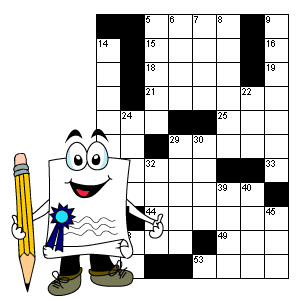
While I was cleaning up the music room (students are messy at every age), I noticed that one of the students left their history assignment, which was a word puzzle on the civil war.

I was about to toss the puzzle out, when it hit me. Why not create a musical word puzzle!

I scoured the net until I found a number of websites that allowed you to create your own word puzzles.

Instead of Bach and Beethoven, I decided to make the word puzzle a bit hipper.

I used the names artists that the students knew like Drake and Nikki Minaj, but I also added artists like Prince and the The Beatles to give the word puzzle a sense of music history.

The word puzzle had around 25 names and it was pretty difficult, so I allowed the students to work in groups, but I said it was also a competition to see which group could correctly finish the puzzle first.

Surprisingly, the students really got into it.

I would walk around and to give words of encourage, but if I noticed a group that was doing more talking than solving, I would change the group's members.

For groups that were moving a little slower, I would say “You guys doing a great, but **Keisha’s group is almost finished. I know you can do it, but you might need to work a little harder.”

I believe that slight nudge helped some of the students focus and work as a team.

When I passed the puzzle out to the next class, some of the students said it was too hard.

I responded by showing them the puzzles of the previous class and said that while the puzzle is tough, the last class was able to finish it and I knew they had the ability to do the same.

Towards the end of class, we talked about the artists that the students didn't know.

Most of the time, I didn't have to say much because there was always a student who said their parent brother, aunt,etc. exposed them to an artist like Led Zeppelin or Al Green and they would rattle off some facts about the artist, (if there was one older artist that students knew the best it was Michael Jackson, which is amazing since most of them were born way after his peak.)

Although word puzzles may not work in every class, it's a great and fun way for students focus and promote teamwork.

(* Have you ever been in position where you were without a lesson plan? What did you do to make a stressful situation, a productive one?

(* *Keisha is a fake name, but her group did finish first. )

Try these sites to create your own word puzzle:

www.puzzle-maker.com

www.puzzle-maker.com/CW/

www.discoveryeducation.com/puzzlemaker/  

http://www.superkids.com/aweb/tools/words/search/

www.edhelper.com/crossword_free.htm

www.armoredpenguin.com/crossword/

www.crosswordpuzzlegames.com/create.html

Wednesday, January 26, 2011

Every Class is A Different Stand-Up Routine


When I was in college I was a DJ performing on the radio and in the clubs.

One of the principals of being a successful DJ knows how to read the room. You might play a set of the songs that a crowd loved one weekend, but those same songs could people off the dance floor the next weekend.

Stand-up comedians are the same way.

Where a set of jokes might kill during the 8PM show, those same jokes may fall flat at the 10PM show.
Being a teacher has a lot of these same principals.

Unless you are assigned for consecutive days, where students become familiar with you, walking in as a substitute teacher is like the first day of school every day.

On the first day of school, a teacher meets their students for the first time, but by the end of the month that same teacher realizes what buttons to push to help their students succeed.

My personality is quite fun loving and relaxed, but I realized quickly that my personality may work on some grades and classes, but fail miserably in others.

I taught a high school English class where some kids were disruptive as we read stories out loud. Luckily for me, my humor helped me calm those students down and in fact one of those disruptive students actually read in class for the first time!

However, a few periods later, my humor did not save me.

The assignment was the same, but tactic I used to get the students to read did not work. Where In the last class I had a few kids talking, in this class kids were actually going to sleep!

I was at my wits end, when the teaching assistant told me that this particular class likes to stand up and read the story as a play than to sit in their seat and the read the book out loud.

I quickly pivoted and asked for volunteers to perform the story as a play. Surprisingly enough I had more kids than parts.

Although the class only performed only a couple of pages of the book that information from the teaching assistant saved what would have been a wasteful day in class.

While most teachers leave notes to let you know what works in particular classes, sometimes subs are left to figure out what motivates a class by themselves without the help of a fairy godmother aka teaching assistant.

Like DJ’s and stand-up comedians, the ability of a teacher to read a class room takes years to perfect, but for subs, years are reduced to precious minutes to quickly figure or may not work in a classroom.

For substitute teachers, what method do you use to connect with your students? (I like to hear the good, the bad and the ugly).
For long time teachers, how long to did it take to figure out what works best in your classroom and what happens if you can’t connect to your students?

Stopped a School Fight...Scolded By Office

One of my first assignments as a substitute teacher was a physical education class in a middle school.

During my one of my classes there seemed to be a growing disturbance between a group of girls and another young lady who was developmentally challenged.
At some point during the class, a fight broke out between the girls.

As I stopped the fight out to find out what happened, I realized quickly that the fight wasn’t as simple as the group of the girls jumping on the special needs child.

In actuality, both of them said things that were derogatory to each other and seemed more likely that the special needs girl started the fight. With no resolution in sight, I decided to take all of them should be sent to the office.

Once I took the girls to the office, the secretary asked me who was watching the gym. I said no one. I was immediately reprimanded by the unit principal for leaving my class and was told to go back to the gym.

Once I went back to the gym, I noticed that the office that was in was ransacked and although my personal positions were not taken, (I put them in secret compartment buy the desk) all of the basketballs that were secured in the back room were gone.

I immediately shut everything down, retrieved the basketballs and made the kids sit until the bell rang.

Although I was probably wrong for leaving the gym that was the first time I was involved in a fight and I didn’t trust the girls to go to the office on their own. Nowadays, I know it’s best to contact security in those situations, but I still question what the best way to handle a school fight.

For my educating friends out there, how would you handle this situation differently or how have you handle fights during your time as teacher?

Tuesday, January 25, 2011

ROTC Rocks!

I was in a high school one day where I was monitoring the open gym at lunch time.

I assisted by the ROTC commander at the school and we got into a discussion about his program.

He was a cool dude with a buzz cut and a definite military structure, but he had a jovial urban slant in his speech that embraced him his ROTC kids and non-ROTC kids alike.  

He told me that he was in the military for a long time and he was looking for a new challenge. 

When the opportunity arose to run ROTC program at this high school, he jumped at the chance.

During our conversation, he told me about the physical training that kids go through on weekly basis., Now for a non-work out person like myself , it seemed like a lot, but in essence, those  students were arguably in better shape physically than their most of the peers AND their  teachers.

He noted that ROTC gives his kid a structure that some may not have at home or in the other cases strengthens the path of success for those students who are either headed to the military or remain as civilians.

The best part of our discussion was when he told me when they have events where the ROTC cadets receive awards.  

The parking lot and the gym are packed full of parents, guardians, friends and family who cheer on the cadet’s success. This type of the support means a lot to the ROTC students and it reinforces that their hard work actually meant something.

In contrast, he mentioned  that there very  few cars and even less parents who attend the  parent- teacher conferences, which is a shame since no- ROTC kids also needs that kind of encouragement.

This is not say that every kid should be in ROTC, but maybe some of the structured principals from ROTC should be adapted into schools where the grades are low and the lack of disciple is high.

But if parents do not get involved in PTA or even attend parent’s teacher conferences that child might not reach their full potential.

If they see that their parents do not care about their education, whys should they?

*(If you are part of ROTC program, can you tell us the success stories of your students?   If you subbed in a ROTC program or worked in a school that was discipled, can you tell us the difference between that school and a regular school?)

What To Do With School Absenteeism

A month after I was at the middle school with the tardy kids, returned there for another assignment.

One of my duties this time was to call the homes of the kids who were absent to see why they did not attend school that day.

As much as I was shocked by the kids who were tardy, I was even more surprised by the number of the kids who were absent, which was about a page and a half, (the secretary told me that the list usually longer than that!?!)

  • Amazingly, most the calls went pretty fast:


* About half of the phone numbers were disconnected (probably due to people losing their cell phone service).

  • Some of the parents/guardians could not speak English, so it was difficult to ask them about their child, (there should be a bi-lingual educator on staff who should handle these calls).


  • I left quite a few messages on voicemail, which at times felt like I was calling a club due to music and slang that I heard on the voice mails, ( Hey its C-Dizzle, you know what to do…Beep!)


But some of the calls were encouraging.

  • The parents/guardians whom I was able to connect with told me they forgot to call the school to report the child’s absence and some asked me about the child’s homework.

  • Unfortunately in other cases, the parent/guardian did not know their child was absent  from school that day.


When I was growing up, the very thought of me skipping or flicking school wasn’t in my vocabulary.

 I knew once the school called my home, my mom and then my dad would punish me swiftly. 

I know that kids skipping school is nothing new and this has been going on schools began, but having nearly two pages or more of children absent is quite frighteningly because some of these kids might not ever come back.

It’s hard enough to find a job with a degree, but to try to find a job with a limited education, makes the world a much tougher place to survive.

So why do you think so kids skip school these days?

What do you think parents and school systems should do to decrease these numbers?  

Should we give kids incentives for going?

Monday, January 24, 2011

...And You're Late Because?

One day I had an assignment at a middle school, where part of my duties was to sign in students in who were late for homeroom.

Growing up, the only time I was late was if I overslept, (which as rare since my mom mad sure I got up on time).  I figured, how many kids could possibly be late for school?

Umm... a lot

By the time the last home room bell rang, I was deluged by over 20 kids waiting for me to sign hall passes for homeroom, (the line was so long, I thought the kids were waiting for the next Twilight movie).

At first I began filling out the slips carefully, but because there so many kids, I had to write fast. Astonishingly, some of these kids became upset with me.  

Some kids were upset that I wasn’t writing fast enough (really!?!), while others were frustrated because I wrote their name wrong, (hey kid, blame your parent for your name, not me).  

The thing that was most shocking was that neither one of the two secretaries didn’t help me at all until one realized that I was completely overwhelmed and she reluctantly assisted me filling out hall passes.

There were a few kids who had their parents with them and they explained their child was late, but the rest of these kids didn’t have an excuse for their tardiness, (I later found out that most the tardy students are usually on school grounds before the bell rings, but they rather hang out with their friends than go to homeroom).

For kids who are late, they are sent to detention during lunch time.

The guy running the detention lunch hour was pretty tough, but I don’t think that he nor the detention was much of deterrent, especially since quite a few of the kids were tardy on a regular basis.

I think if you are tardy for homeroom more than three times, you don’t have detention for lunch, you actually have to help clean up during the lunch hour.  

This means sweeping the cafeteria, cleaning lunch tables and dumping trash.  

No child, especially during their puberty years, does not want to be seen cleaning up their peer’s Jell-O Pudding cups. Though embarrassing, this might be a way to make sure kids show up on time for school.

During your assignments, have you encountered kids being late for homeroom?

What did the school or teachers do to alleviate this problem?

Follow Us On Facebook

Pages